








Simple Ways to Teach Toddlers and Preschoolers to Tell Time
"Is it time yet?" If you have a little one at home, you have probably heard that question more times than you can count. Time is a big, invisible idea for small children. They can't touch it or see it, and "five more minutes" can feel like forever.
The good news is that you don't need worksheets or flashcards to get started. Long before your child can read a clock, they can begin to understand how a day moves along. Here are some simple, playful ways to build that understanding at home, one small step at a time.
Start with the rhythm of your day
For toddlers, time is not about numbers. It is about what comes next. Breakfast comes after waking up. Bath comes before bed. A predictable routine is your child's very first clock.
Try talking through your day out loud:
"First we brush our teeth, then we read a story."
"After lunch, it's quiet time."
"When the park is done, we go home for a snack."
Words like first, next, after, before and later are the building blocks of time. The more your child hears them in everyday moments, the more natural they become.
A picture schedule can help too. Draw or print simple pictures of your daily routine (wake up, eat, play, nap, bath, bed) and line them up on the fridge. Your child can point to what is happening now and what is coming next.
Talk about day and night
Day and night is one of the easiest time ideas for little ones to notice, because they can see it happen. Make it part of your chats:
Look out the window together in the morning and at bedtime. What looks different?
Ask, "Is the sun up or is the moon out?"
Sort pictures or toys into "things we do in the day" and "things we do at night."

Over time, children start to link activities to parts of the day: morning, afternoon, evening and night. That is a big step toward understanding that the clock follows the same pattern every day.
Make a pretend clock together
Little hands learn best by doing. A homemade clock turns an abstract idea into something your child can hold and move.
You will need a paper plate, a marker, and two strips of card for the hands (one short, one long). A split pin or a bit of play dough in the middle works to hold the hands in place.
Write the numbers 1 to 12 around the edge. If that feels like a lot for your child, start with just 12, 3, 6 and 9 and add the rest later. Then let your child move the hands however they like. At first it is simply play, and that is exactly the point. They are getting used to how a clock looks and how the hands go around.
Begin with o'clock times
When your child is ready to read a clock, start with the easiest times: the o'clock hours. Keep the long hand pointing straight up at the 12 and only move the short hand.
You might say, "The long hand is on the top, and the short hand is on the 7. That means it's 7 o'clock!"
Then connect it to real life:
"At 7 o'clock we have breakfast."
"At 12 o'clock it's lunchtime."
"At 7 o'clock tonight, it's bath time."
Once o'clock times feel easy, you can move on to half past, then quarter past and quarter to. There is no rush. Every child gets there at their own pace.
Play simple matching games
Games make practice feel like fun instead of work. A few easy ideas:
Clock match: Draw a few clock faces showing o'clock times, and write the same times on separate cards. Your child matches each clock to the right card.
Routine match: Pair a clock showing 8 o'clock with a picture of breakfast, or 7 o'clock with a picture of bedtime.
Find the clock: Go on a hunt around the house or out shopping. How many clocks can you spot? Is each one round with hands, or does it show numbers only?
That last game is a gentle way to introduce the idea that clocks can look different. Some have hands, and some just show numbers. Both tell us the same thing.

Use time words during the day
You can bring time into everyday moments without making it feel like a lesson:
"Let's set a timer for five minutes of tidy up time."
"Grandma is coming after your nap."
"We have time for one more slide, then we go home."
Sand timers and kitchen timers are wonderful tools here. Watching the sand fall helps children see that time really does pass, even when they can't feel it.
Keep it short, light and fun
Little ones have short attention spans, and that is perfectly normal. A few minutes of play here and there will do more than one long session. If your child seems tired or frustrated, put the clock away and try another day.
Celebrate the small wins. Noticing that the sun is setting, saying "after lunch" on their own, or moving the short hand to 3 are all real progress.
A playful next step
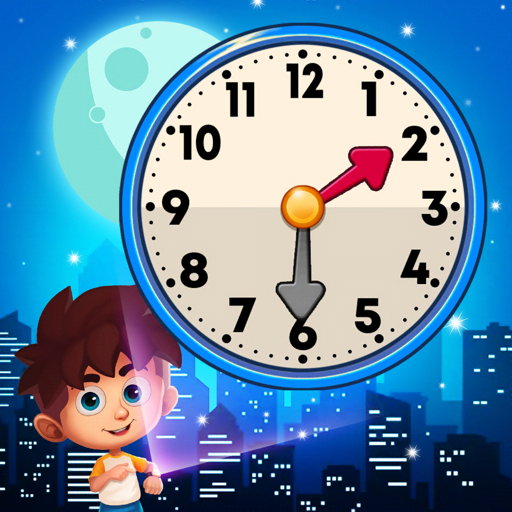
When your child is ready for more clock practice, Telling Time Academy, our app from 123 Kids Academy for kids ages 4 to 8, turns these same ideas into hands on play. Kids can move the hour and minute hands to set the time, match analog clocks with digital times, put clock puzzles together, play the Stop the Clock game, and explore how time changes from day to night. There are five difficulty levels, so children can grow at their own pace, and they earn coins along the way to build their very own city.

The app is free to download, with some games and higher levels unlocked through an in app purchase. It is available in English, French, German, Spanish, Japanese, Simplified Chinese and Traditional Chinese.
If that sounds like a good fit for your family, you can find Telling Time Academy on the App Store and Google Play.
However you choose to practice, remember that every "is it time yet?" is a chance to learn something new together.

Comments